
Ubisoft Mainz has detailed Aegyptus, the new province planned for Anno 117: Pax Romana’s Dawn of the Delta expansion. The first DevBlog shows how limited farmland, seasonal flooding, and a south-to-north river will shape where players build and how they move goods. The expansion is announced for November 5, 2026.
Aegyptus replaces the familiar open-water separation between buildable areas with a river delta, though cargo still travels between them by ship. Each area also has Farmland, Floodplains, and an Arid Zone with different uses. The newly described geography makes the earlier announcements about irrigation and local ship types easier to understand: both address constraints built into the province itself.
Three Zones Compete for Building Space
Farmland is the limited green strip along the water. It supports early crops such as dates and oats, and it is the only zone where a harbor can be built. That puts fields and access to shipping on the same scarce coastal ground. Choosing a harbor site therefore also affects how much suitable space remains for early agriculture. This official short video accompanies the developer’s Farmland explanation.
Floodplains beside the river can supply mud and reed for sun-dried bricks, as well as support crops such as wheat and barley. Fertile mud increases production from buildings placed there, according to the DevBlog, while regular floods also affect those buildings. The blog does not give a numerical production bonus or spell out every flood-season effect. The same zone is therefore valuable for both farming and construction materials, with flooding part of the location decision.
The Arid Zone has room for residences, public services, and production buildings that do not need fertile ground. Keeping those buildings there can leave more Farmland for crops and the harbor, and more Floodplains for their resources. Agriculture in the Arid Zone requires irrigation. Cliffs and small mountains still limit usable space, although they can provide slots for mining ore or stone.
The River Shapes Shipping Routes
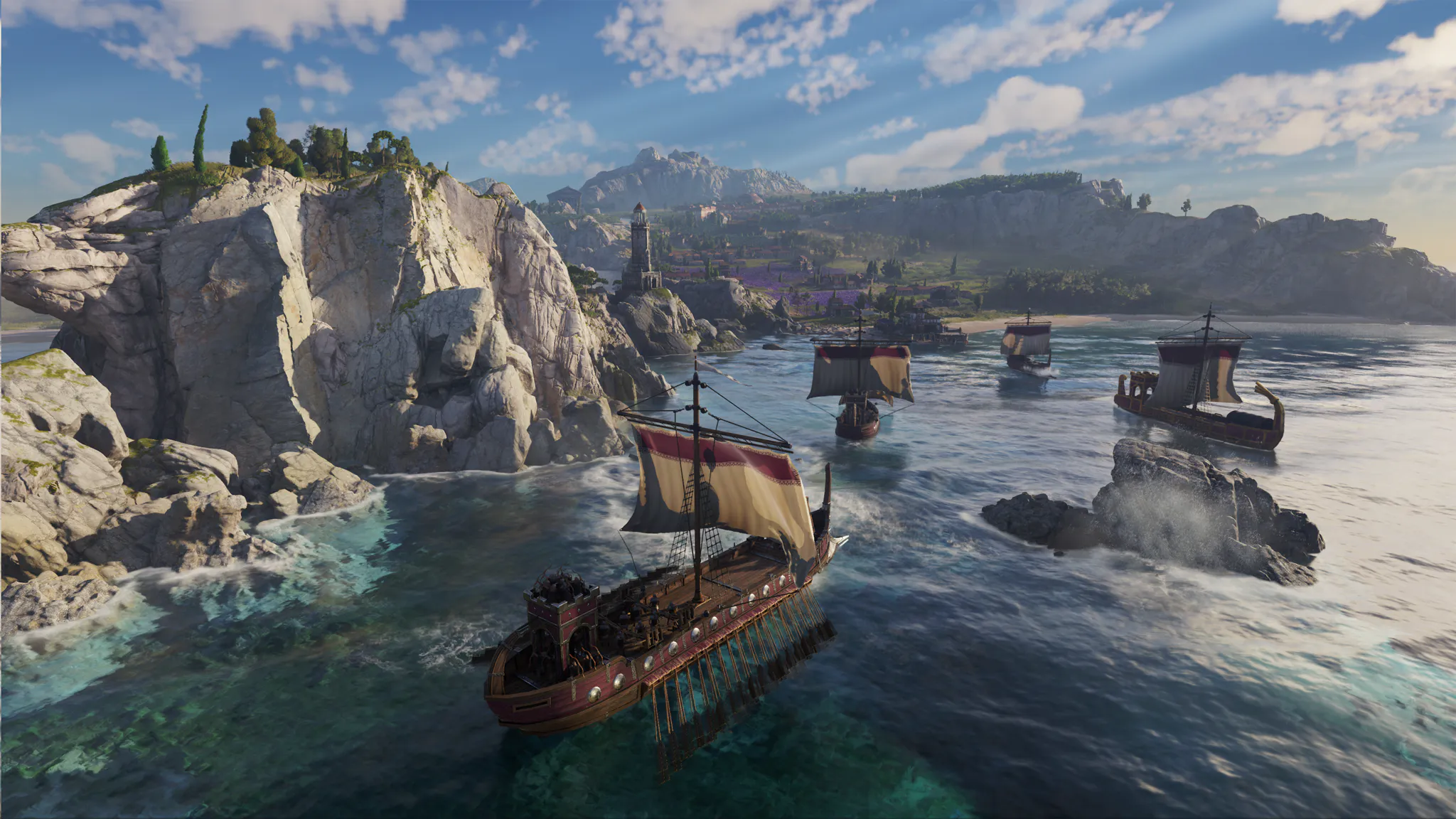
Aegyptus’s buildable areas sit closer together than islands across an ocean, but their elongated shapes can still make ship journeys longer. The province is entered from the north. Its river flows from south to north, affects ship speed, and slows the heavy Roman vessels used elsewhere. A settlement’s position matters for both local transfers and trips to other provinces, alongside its building room and fertility.
The developer suggests that a northern trade hub could spare interprovince ships a long journey upriver to load or unload. It is a planning suggestion, not a prescribed layout. In its September Gamescom recap, the publisher had already announced two local ship types that would be significantly faster on rivers than Roman ships. Neither source provides exact ship speeds.
How the First Settlement Fits Together
The DevBlog’s example starts on an island in the northern delta with Threshers, the first local population tier, whose focus is agriculture. The developer builds a Firepit to meet a public-service need and a Date Farm on fertile Farmland for food. The farm requires nearby trees, so a fertile plot by itself is not enough for that particular building.
Early construction in Aegyptus calls for Mud Bricks in place of wood. Their reed and mud come from the Floodplains. People can also collect beads there to make Wesekh Collars for a fashion need. The example ties early food, building materials, and a consumer good to different parts of the settlement without establishing a universal build order. The DevBlog does not specify construction costs or complete recipes.
Earlier Irrigation Plans Explain the Scarcity
The publisher’s September 3 Gamescom recap had already outlined two ways to make more ground fertile: connecting basins with canals, or, on the Romanized path, using a noria to carry water through aqueducts toward a cistern. The October map details clarify why those systems matter. Limited Farmland supports the initial settlement, while irrigation is the proposed way to bring agriculture farther into the Arid Zone.
That earlier recap also introduced a choice between developing local traditions and following a Greco-Roman path. Threshers could advance to Potters on the Aegyptian path or Scribes on the Greco-Roman one, with different needs and public services. The first October DevBlog focuses on the province’s terrain and a starting example; the publisher says later entries will explain more of the population and production systems.
What Comes Next for Aegyptus
Ubisoft Mainz says it designed Aegyptus as a more static, connected river landscape than the archipelagos of Latium and Albion. Its developers describe adapting river rendering and ship placement to that layout. The result is still a province divided into buildable areas that rely on ships for goods transport.
With the DLC enabled, Aegyptus is planned as either the starting province for a new game or a destination in an existing save. The official DevBlog announces Dawn of the Delta for November 5, 2026, on all platforms. Its next entry is scheduled for October 22 and is set to cover population, production, flooding, and irrigation in more detail. The official teaser below introduces the pyramids as a subject for a later blog.
Sources
Cover Image: Ubisoft · newsroom.ubisoft-press.com
Comments
No comments yet. Start the conversation.
Join the Community
Sign in or create a free account to comment. Comments are moderated.